From Cardboard Records to Synthesizers
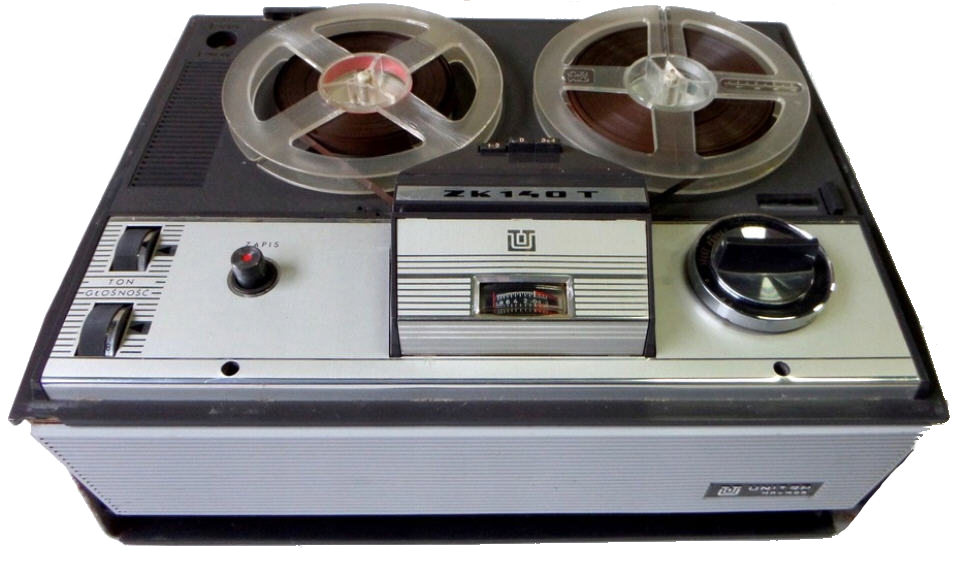
Chasing the Sound: How a Reel-to-Reel Tape Recorder Changed My Life
Tags: #MusicHistory #Synthesizers #Memories #JeanMichelJarre #DIYMusic #GrowingUpInPoland
Looking back, I realize that I have always been sensitive to sound. But in my early childhood, the sources of that magic were scarce. We didn’t have Spotify or YouTube; my world was defined by what I could catch on the radio, the crackle of an old gramophone, and the unique, lo-fi charm of something called in Polish "pocztówki dźwiękowe" (cardboard record)—those flimsy, plastic photos that you could actually play on a turntable.
Beyond that, the only massive, enveloping sound I experienced was in church, where pipe organs produced sounds that amazed me. But everything changed when I turned seven and started school.
That was the year I saw a tape recorder for the first time.
It wasn’t just a machine; it was a portal. The idea that you could trap sound and replay it whenever you wanted was mesmerizing. From that moment on, I had only one wish. I didn't want toys; I wanted a reel-to-reel tape recorder. I talked about it incessantly, wearing my parents down with my enthusiasm, until the big day finally arrived.
For my First Communion at age eight, I received the gift I had been dreaming of: my very own tape recorder. That was this monstrous thing (weighting something like 8kg). It was monophonic, 4 track recorder.
The Hunter of Sounds
The first thing I did was connect that machine to the radio. In those days, Polish public radio was a goldmine for a kid with a blank tape. Unlike today's stations that play singles with commercials in between, the radio back then would often broadcast entire albums uninterrupted.
My first great "catch" was the Bee Gees' Saturday Night Fever. I recorded the entire record, front to back. I remember sitting there, watching the reels spin, feeling incredibly lucky to have captured that energy. That method became my library; it was how I collected hours of truly amazing music.
The Electronic Awakening
While I loved the pop and rock I was collecting, something shifted the day my brother walked in with a reel-to-reel tape of Equinoxe by Jean-Michel Jarre.
I pressed play, and my jaw hit the floor. How did he get those sounds?
It didn't sound like a guitar, and it didn't sound like a piano. It sounded like the future. When I later heard Oxygène on the radio, my fascination deepened. I became obsessed with textures and atmospheres, rhythmic arpegiated patterns.
This opened the floodgates to other electronic pioneers. I remember hearing Vangelis and Jon Anderson’s "I’ll Find My Way Home." That track, along with the rest of The Friends of Mr Cairo, felt like a journey to another world.
Rock, Prog, and Storytelling
My musical palette continued to expand. I fell in love with the unique "white reggae" of The Police album "Reggatta de Blanc", but I also gravitated toward the complex structures of progressive rock giants like Yes and Genesis.
I wasn't just looking West, though. I hold a special place in my memory for the Polish band Budka Suflera, specifically their early album Ona przyszła prosto z chmur ("She Came Straight from the Clouds"). And on the storytelling side, Chris de Burgh fascinated me—not the "Lady in Red" era, but his earlier, more atmospheric albums like Spanish Train and Other Stories and The Getaway.
The Urge to Create
Through all of this listening—from Chris de Burgh’s narratives to the rock anthems of The Police—there was one constant thread: the synthesizer.
Whenever a synth line cut through a song, I was hypnotic. The sound was so strong, so compelling, that simply listening wasn't enough anymore. I wanted to make those sounds.
However, this was communist Poland. We had practically nothing in the stores. Walking into a shop and buying a proper synthesizer like a Moog or a Korg was not just expensive; it was virtually impossible for a regular family.
But necessity is the mother of invention. Since my parents couldn't buy me a synth, and I couldn't find one in a shop, I realized I had to take matters into my own hands. My fascination with the sound led directly to a fascination with electronics. If I wanted a synthesizer, I was going to have to build it myself.
But the story of building my first synth—and the melted solder, strange noises, mistakes, failures and triumphs that came with it—is a story for another time.